
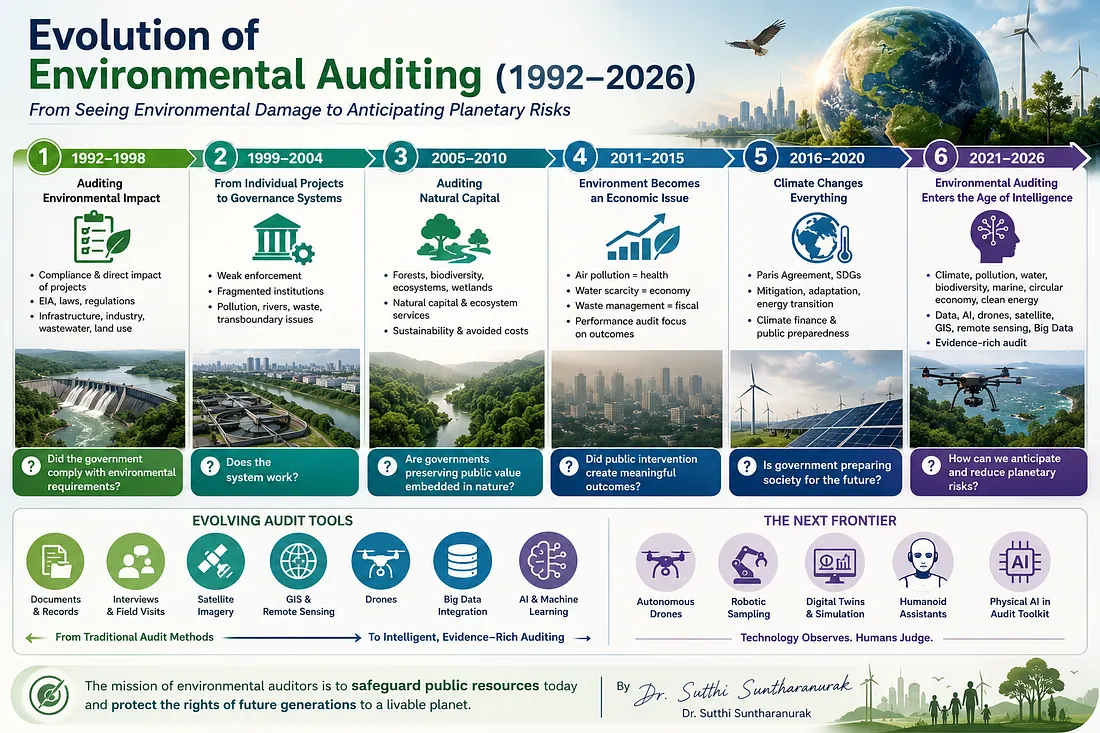
 Synthesis by my research about Evolution of Environmental Auditing since 1992–2026
Evolution of Environmental Auditing (1992–2026): From Seeing Environmental Damage to Anticipating Planetary Risks
05.05.2026
There was a time when environmental auditing was considered a niche area of public audit.
For decades, Supreme Audit Institutions (SAIs) were expected to focus primarily on public expenditure, legality, and financial accountability. Nature was often viewed as an externality—important, but outside the traditional scope of audit.That view gradually changed.
The turning point came in 1992, when the world gathered at the Earth Summit in Rio de Janeiro and formally recognized that environmental degradation, economic development, and governance could no longer be treated separately.
From that moment onward, environmental issues slowly entered the language of accountability.
And auditors began to ask different questions.
Era I (1992–1998): Auditing Environmental Impact
In the early years, environmental auditing focused mainly on compliance and direct impact.
SAIs examined whether governments complied with environmental laws, whether environmental impact assessments (EIA) were conducted properly, and whether infrastructure projects considered ecological consequences.
Typical audit subjects included dams, roads, industrial facilities, wastewater systems, and land use.
At this stage, environmental auditing remained largely project-based.
The underlying question was straightforward:
Did the government comply with environmental requirements?
Era II (1999–2004): From Individual Projects to Governance Systems
As environmental challenges became increasingly interconnected, auditors realized that many failures did not originate from a single project.
Weak enforcement, fragmented institutions, overlapping mandates, and poor coordination often explained environmental outcomes better than technical design alone.
Environmental auditing began to move upward—from site inspection to system assessment.
Pollution, river management, waste governance, and transboundary environmental issues entered audit agendas.
The question evolved:
Does the system work?
Era III (2005–2010): Auditing Natural Capital
During this period, environmental auditing expanded beyond pollution control.
Forests, biodiversity, wetlands, ecosystems, and natural resources became strategic audit themes.
Auditors increasingly recognized that environmental assets function similarly to financial assets.
When forests disappear, governments lose ecosystem services.
When biodiversity declines, economic resilience weakens.
Environmental auditing began introducing concepts that environmental economists had long discussed:
natural capital, ecosystem services, avoided costs, and sustainability.
The question became:
Are governments preserving public value embedded in nature?
Era IV (2011–2015): Environment Becomes an Economic Issue
This period marked another major shift.
Environmental degradation was no longer framed solely as ecological damage.
Air pollution became a healthcare issue.
Water scarcity became an economic issue.
Waste management became a fiscal issue.
Environmental auditing increasingly adopted performance audit methodologies.
The objective was no longer to determine whether government activities occurred.
Instead, auditors asked:
Did public intervention create meaningful outcomes?
Era V (2016–2020): Climate Changes Everything
The adoption of the Paris Agreement and the Sustainable Development Goals transformed environmental auditing globally.
Climate change became more than an environmental issue.
It became a governance issue.
A fiscal issue.
A development issue.
And ultimately, a societal resilience issue.
Auditors started reviewing mitigation policies, adaptation readiness, energy transition, climate finance, and public preparedness.
Environmental auditing entered a new phase:
Climate Accountability.
The question changed again:
Is government preparing society for the future?
Era VI (2021–2026): Environmental Auditing Enters the Age of Intelligence
Today, environmental auditing is evolving faster than ever.
Climate.
Pollution.
Water.
Biodiversity.
Marine systems.
Circular economy.
Clean energy.
Environmental topics are increasingly interconnected.
As a result, audit tools are changing.
Traditional methods—documents, interviews, and field visits—remain important.
But they are now complemented by technologies that were once unimaginable.
Satellite imagery enables auditors to observe environmental changes over time.
GIS reveals spatial patterns.
Remote sensing provides large-scale evidence.
Drones expand visibility into forests, coastlines, infrastructure, and inaccessible areas.
Big Data enables integration across agencies.
Artificial Intelligence helps detect anomalies, classify environmental images, prioritize risks, and accelerate analysis.
Environmental auditing is becoming increasingly evidence-rich.
Yet the role of the auditor remains unchanged.
Technology may collect observations.
Only humans create judgment.
What Comes Next?
The next frontier may arrive sooner than expected.
Imagine an environmental audit where autonomous drones monitor river systems continuously.
Robotic platforms collect environmental samples in hazardous areas.
Digital twins simulate policy outcomes before investments occur.
Humanoid assistants support field inspections and stakeholder engagement.
Physical AI may eventually become part of the environmental audit toolkit.
But even in that future, the essence of auditing will remain deeply human.
Machines may observe.
Auditors must still ask difficult questions.
The Future Is Not About Auditing More—But Auditing Better
Looking back from 1992 to 2026, environmental auditing has evolved from checking environmental damage to understanding systemic environmental risks.
From verifying compliance to strengthening resilience.
From protecting public expenditure to protecting public futures.
Perhaps the mission of environmental auditors in the twenty-first century is not merely ensuring governments spend money correctly.
Perhaps it is helping societies preserve something even more valuable:
the ability of future generations to inherit a world that still works.